
#Metrics
#Purpose
The Metrics section displays live measurements from the simulation. Live metrics refresh about once per second, or every generation below . They are useful for watching population balance, diversity, and boundaries while a simulation runs.
#Controls
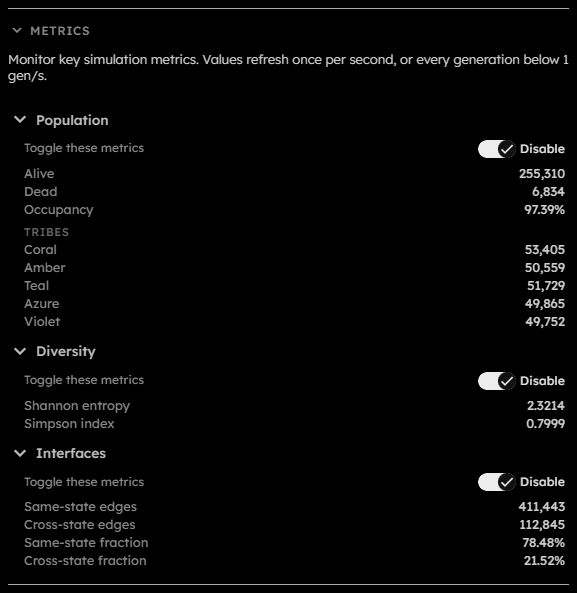
- Population subsection:
Expands or collapses population values. - Diversity subsection:
Expands or collapses diversity values. - Interfaces subsection:
Expands or collapses interface values. - Toggle these metrics:
Each subsection has an Enable / Disable toggle. These toggles are disabled when global live metrics are off in the Speed section.
These fields are persisted across sessions.
#Values
If a live metric section is disabled, values display as disabled. If a section is too large for the GPU counter limits, values display as unavailable.
| Metric | Section | Description |
|---|---|---|
| Alive | Population | Cells that are not dead. |
| Dead | Population | Cells in the dead tribe. |
| Occupancy | Population | Alive cells divided by total cells. |
| Tribe rows | Population | One row for each non-dead tribe showing its population. |
| Shannon entropy | Diversity | How evenly alive cells are distributed across tribes. Higher values mean more even distribution. |
| Simpson index | Diversity | Probability that randomly selected alive cells belong to different tribes. |
| Same-state edges | Interfaces | Orthogonal neighbor edges connecting cells with the same state. |
| Cross-state edges | Interfaces | Orthogonal neighbor edges connecting cells with different states. |
| Same-state fraction | Interfaces | Same-state edges divided by total contact edges. |
| Cross-state fraction | Interfaces | Cross-state edges divided by total contact edges. |
Toroidal grids include wrapped contacts across opposite edges. Bounded grids count only contacts between cells inside the finite grid; virtual boundary cells and opposite-edge wrapping are excluded.